How to Calculate a Percentage: A Simple Everyday Guide
A step-by-step explanation of percentages, with worked examples and a quick way to check your answer.
Start with the whole
A percentage describes an amount out of one hundred. Before you calculate anything, identify the whole: the quantity that represents 100%. If 18 out of 60 seats are occupied, the whole is 60 seats, not 18. Choosing the wrong starting amount is one of the easiest ways to get a misleading answer.
Find a percentage of an amount
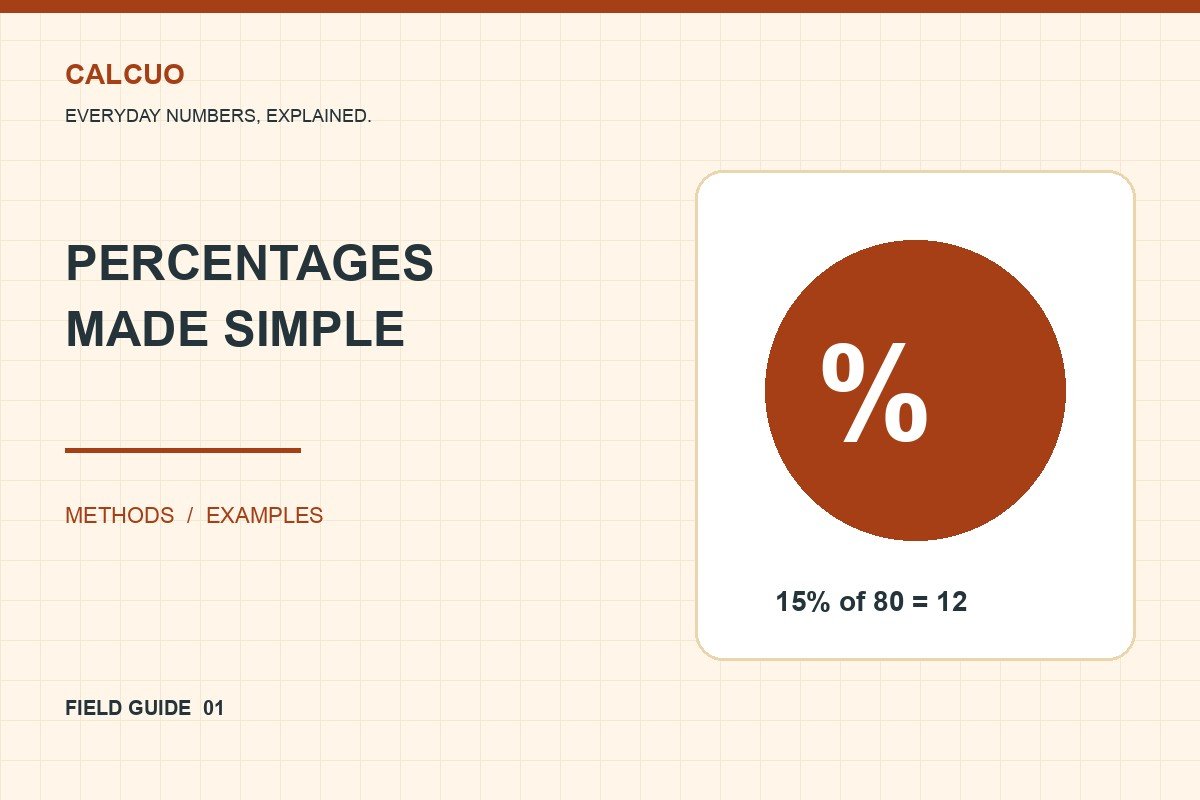
To find p% of an amount, divide p by 100 and multiply by that amount. For example, 15% of 80 is 0.15 × 80 = 12. The same method works whether the amount represents objects, distance or an illustrative price. Keep the units in your answer: 12 items, 12 kilometres or 12 currency units.
Find what percentage a part represents
Divide the part by the whole, then multiply by 100. In the seat example, 18 ÷ 60 × 100 = 30%. Notice that this is a different question from finding 18% of 60. Write the question in words before choosing the calculation.
Use mental checks
Ten per cent is one tenth, so 10% of 80 is 8. Five per cent is half of that, or 4. Add the two results and you get 12, which confirms the 15% calculation. Other useful anchors are 50% for a half and 25% for a quarter. These checks help catch a misplaced decimal point.
Work backwards carefully
If 12 is 15% of an unknown whole, divide 12 by 0.15 to get 80. Dividing by 15 would give the wrong scale. You can verify the answer by calculating 15% of 80 again. A reverse calculation is particularly useful when a worksheet gives a part and its percentage but leaves out the original amount.
Round at the end
Keep extra digits during the calculation and round only when reporting the result. If 7 out of 24 tasks are complete, the result is approximately 29.17%, not exactly 29%. Choose a precision that suits the context and label rounded answers as approximate. A percentage has no meaning without a clearly stated whole.