Minutes to Decimal Hours: A Step-by-Step Conversion
Convert hours and minutes to decimal hours without confusing clock notation with decimal notation.
Remember the base is sixty
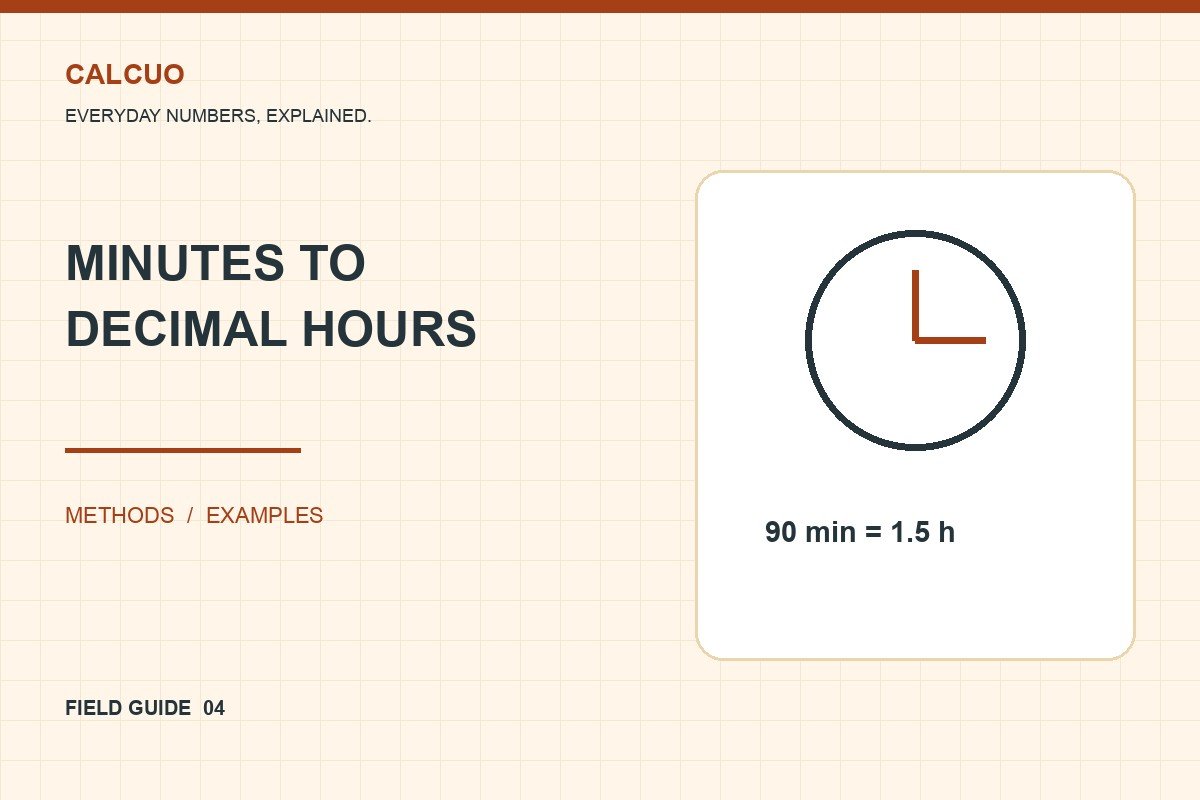
Hours and minutes use a different structure from ordinary decimal notation. One hour contains 60 minutes. A time duration of 1 hour 30 minutes is therefore 1.5 hours, not 1.30 hours. The digits after a decimal point represent fractions of an hour rather than a number of minutes.
Convert the minutes first
Divide the number of minutes by 60. For 45 minutes, calculate 45 ÷ 60 = 0.75 hours. For 20 minutes, calculate 20 ÷ 60 = 0.333… hours. Some conversions produce repeating decimals, so keep additional digits until you are ready to report the result.
Add any complete hours
For a duration of 2 hours 45 minutes, add 2 to 0.75 to get 2.75 hours. Another reliable approach is to turn everything into minutes first: 2 × 60 + 45 = 165 minutes. Divide 165 by 60 and you arrive at the same result. Use whichever method makes your working easiest to check.
Convert decimal hours back
Keep the whole hours and multiply the decimal part by 60. For 3.4 hours, the fractional part is 0.4. Multiplying 0.4 by 60 gives 24 minutes, so the duration is 3 hours 24 minutes. It is not 3 hours 40 minutes.
Add durations before rounding
If three tasks take 20 minutes each, their exact total is 60 minutes, or one hour. Rounding each task to 0.33 hours first would give 0.99 hours. To avoid that discrepancy, add the minutes first or retain enough precision while adding the decimal values. Round the final total according to the required reporting convention.
Distinguish duration from time of day
These methods convert durations. Calculating the time between clock readings may require accounting for midnight, dates or time-zone changes. If a system asks for decimal hours, check its instructions and rounding rules rather than guessing. This guide does not establish payroll or billing rules; it only explains the conversion.