Ratios and Proportions: How to Scale a Recipe
Use a scaling factor to adjust ingredient quantities while keeping proportions consistent.
Find the scaling factor
A recipe for four portions can be adjusted to six portions by multiplying each ingredient quantity by 6 ÷ 4 = 1.5. That number is the scaling factor. Start by writing down both the original number of portions and the number you actually need so that you do not accidentally reverse the division.
Apply the factor consistently
Suppose the original recipe lists 200 g of an ingredient, 120 ml of a liquid and 80 g of another ingredient. Multiplying each quantity by 1.5 gives 300 g, 180 ml and 120 g. Keep the original units attached to every figure. Changing only one ingredient will change the proportions rather than simply scale the recipe.
Understand a simple ratio
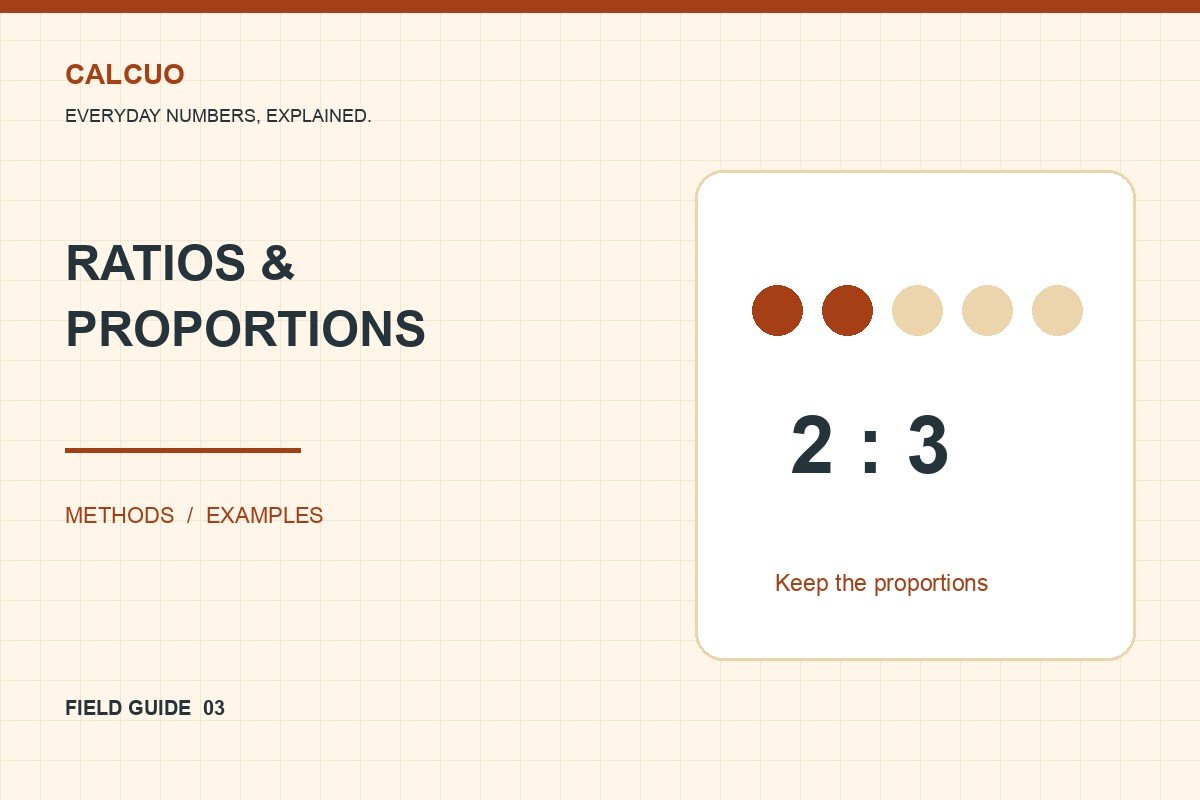
A ratio of 2:3 means two parts of one quantity for every three parts of another. There are five parts altogether. For a total of 500 g, one part is 100 g, so the two quantities are 200 g and 300 g. The ratio is not the same as saying that the first quantity is two thirds of the total.
Reduce before you compare
The ratios 200:300 and 2:3 express the same relationship. Dividing both sides by the same nonzero number preserves the ratio. This makes it easier to compare two mixtures on paper, provided the quantities use comparable units. Do not directly compare a mass with a volume as though both were the same type of measurement.
Handle awkward quantities thoughtfully
A factor can produce an inconvenient quantity, such as one and a half eggs. Decide whether a practical measurement is possible or whether a different batch size would be easier. Rounding several ingredients independently can noticeably alter a small recipe. Record any adjustments rather than assuming that the scaled version is mathematically identical.
Separate arithmetic from cooking decisions
Scaling quantities does not guarantee that cooking time, pan size or temperature should be multiplied by the same factor. Those depend on the recipe and equipment. This guide explains arithmetic, not cooking safety. Follow suitable recipe and food-safety instructions, and use the scaled numbers as a starting point rather than an automatic replacement for those instructions.