Centimetres, Metres and Kilometres: A Practical Conversion Guide
Learn the direction of common metric length conversions and check whether your answer makes sense.
Write the unit beside the number
A number such as 250 is incomplete as a measurement unless its unit is clear. A length of 250 centimetres is very different from 250 metres. Write both the starting unit and the target unit before calculating. This small habit helps prevent mistakes when copying measurements between a sketch, a note and a spreadsheet.
Move between centimetres and metres
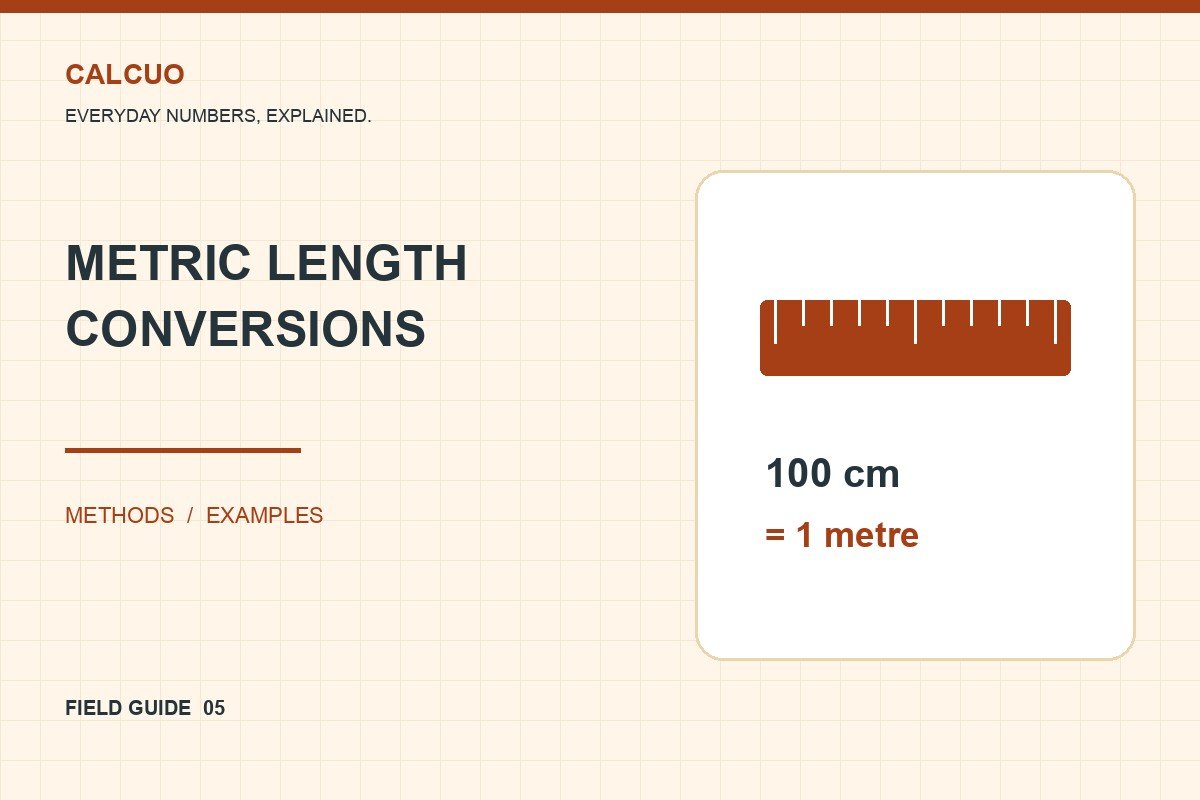
There are 100 centimetres in one metre. To convert centimetres to metres, divide by 100. For example, 250 cm is 2.5 m. To convert metres to centimetres, multiply by 100, so 1.8 m becomes 180 cm. A larger unit requires fewer units to describe the same length.
Move between metres and kilometres
There are 1,000 metres in one kilometre. Divide metres by 1,000 to express them as kilometres: 3,600 m equals 3.6 km. Multiply kilometres by 1,000 to express them as metres: 2.4 km equals 2,400 m. The physical distance stays the same; only its numerical description changes.
Use conversion factors explicitly
You can write 250 cm × (1 m ÷ 100 cm) = 2.5 m. The centimetre units cancel, leaving metres. Writing a conversion factor this way is useful when a problem involves several steps. It also shows why the calculation uses division rather than relying on a remembered instruction to move a decimal point.
Do not reuse a length factor for area
A square metre contains 10,000 square centimetres, because both dimensions are multiplied by 100. A one-metre square measures 100 cm by 100 cm. Simply multiplying an area in square metres by 100 would therefore be incorrect. Likewise, volume conversions require considering three dimensions rather than applying a length conversion unchanged.
Check precision and plausibility
Converting units does not make a measurement more accurate. If an original measurement is approximate, label the converted value accordingly. After calculating, ask whether the number should have become larger or smaller. A 250 cm object should not become 25 m. Finally, convert the answer back to the starting unit as a quick check.